
The Fansial Network
Friend Network
Fansial Verified Business ID
The Fansial Network
ID#7
NetworkFriend
City
Location
Description
Network
Fansial Network is an opted-in business network where businesses may be financially verified and address-verified as needed. Businesses can collaborate, fans can look for discounts, and organizers can seek sponsorships when a business is listed as a Sponsor.


Why Should Technology Solutions Remain Hidden in Corporate Silos in the Age of AI?
Rated:  , 0 Comments
, 0 Comments
Total hits: 83
Posted on: 10/13/26
Why Should Technology Solutions Remain Hidden in Corporate Silos in the Age of AI?
Play
A 4FANZ® Vision — TechMalls.com | TheSIAgents.com | FanCOMM2™
From Enterprise Software and AI Agents to Defense Systems, Drones, Shipbuilding, and Industrial Manufacturing — The World Needs a Marketplace of Solutions, Not More Information Silos.
The Question We Asked Before the AI Revolution
When we initially envisioned TechMalls.com, we questioned something that the technology industry had accepted for decades:
Why is there no universal technology marketplace where businesses, startups, engineers, researchers, and customers can discover, browse, compare, and connect with providers of existing technology solutions?
For decades, technology companies developed extraordinary products and solutions, but much of that knowledge remained fragmented across corporate websites, individual product teams, sales presentations, private customer meetings, and enterprise marketing campaigns.
A large technology company might have hundreds or thousands of products, components, frameworks, patents, and specialized solutions. Yet even its own employees may not know everything the organization has developed.
Why?
Because the traditional enterprise technology business model was built around sales relationships, corporate influence, analyst recognition, conferences, and carefully controlled marketing.
Before AI, this was a comfortable environment.
But the world is changing.
1. AI Is Challenging the Traditional Enterprise Technology Comfort Zone
For years, large technology companies could rely on established relationships, procurement processes, brand recognition, and enterprise sales teams.
A customer looking for an enterprise solution might begin by contacting IBM, Oracle, SAP, Microsoft, Salesforce, or another established vendor.
But what happens when AI can help a small engineering team design, build, test, and deploy software that previously required a much larger development organization?
Consider a few questions.
Could a startup build a credible alternative to Atlassian Jira and license it for substantially less?
Jira is a mature product with years of enterprise development behind it. Replicating its complete capabilities, reliability, integrations, and support would not be trivial.
But does every customer need every feature Jira offers?
Could a focused startup build a simpler project-management and issue-tracking platform for a particular industry at a fraction of the price?
Absolutely worth exploring.
What about Odoo CRM?
Odoo already demonstrates how modular business applications can be built around technologies such as PostgreSQL.
Could another company build a focused CRM using Nuxt.js, MongoDB Atlas, and AI-assisted development?
Of course.
The harder questions would involve security, integrations, reliability, maintainability, data ownership, and customer support.
Nevertheless, the barriers to creating competitive software are changing.
The competitive advantage may increasingly shift from who can build software to who can build the right solution, demonstrate its value, and make it discoverable.
2. Why Should Every Startup Reinvent What Already Exists?
Imagine a startup trying to develop an industrial IoT platform.
Its engineers may spend months researching connectivity, device management, dashboards, security, analytics, and cloud infrastructure.
Somewhere in the world, another company may already have developed 70% of what the startup needs.
But how would the startup discover that solution?
Through Google searches?
LinkedIn posts?
Vendor conferences?
Private sales meetings?
Or by asking an AI assistant that may not have access to the latest privately maintained product catalogs?
This is the problem we want TechMalls.com to address.
Instead of making engineers search an ocean of websites, why not organize technology solutions into discoverable, structured, provider-managed hubs?
A technology mall should work like a real-world shopping mall.
You know where to find electronics, furniture, clothing, and groceries.
Similarly, technology buyers should know where to discover cybersecurity products, ERP applications, AI agents, cloud infrastructure, IoT platforms, robotics, and defense technologies.
3. Introducing TechMalls.com — A Marketplace of Technology Solutions
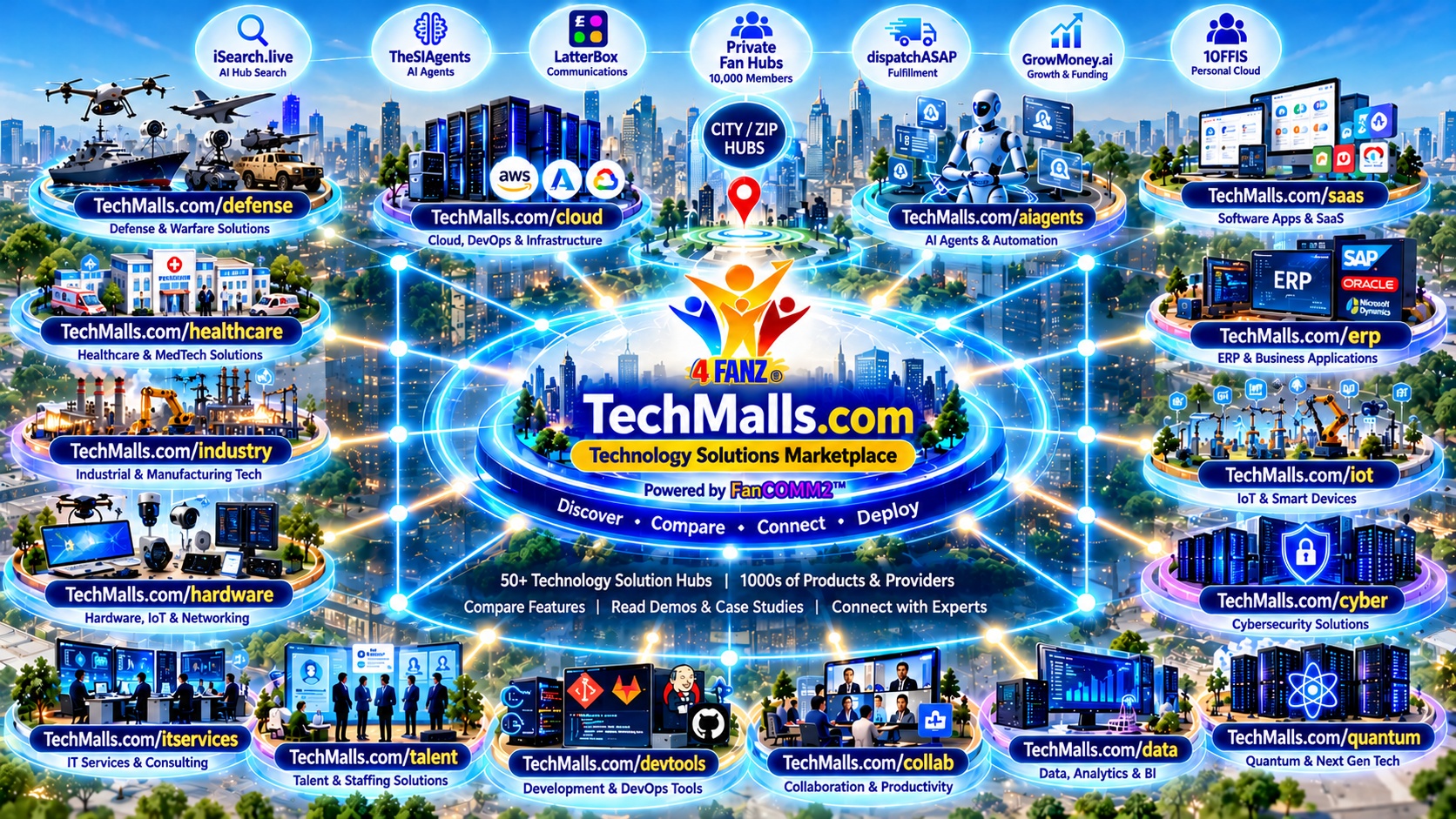
Our vision is to organize technology into dedicated hubs within TechMalls.com, powered by the FanCOMM2™ Super Intelligence Suite.
Illustrative hubs include:
defense.techmalls.com — Defense and Warfare Solutions
aiagents.techmalls.com — AI Agents and Agentic AI
erp.techmalls.com — ERP and Enterprise Applications
saas.techmalls.com — Software Applications and SaaS
iot.techmalls.com — Internet of Things and Smart Devices
cloud.techmalls.com — Cloud, DevOps, and Infrastructure
cyber.techmalls.com — Cybersecurity Solutions
data.techmalls.com — Data Platforms, Analytics, and Business Intelligence
hardware.techmalls.com — Computing, Hardware, and Networking
devtools.techmalls.com — Software Development and DevOps Tools
talent.techmalls.com — Technology Talent and Staffing Solutions
industry.techmalls.com — Industrial Automation and Manufacturing
quantum.techmalls.com — Quantum and Next-Generation Technologies
These are proposed marketplace categories and subdomain structures, not a representation that every hub is already operational.
Each participating technology company could maintain its own digitalFrontDoor™ and structured solution catalog.
Product teams could publish descriptions, specifications, capabilities, supported technologies, diagrams, videos, case studies, and approved technical documentation.
Enterprise marketing teams could transform reusable customer presentations into public solution pages, while retaining confidential information within appropriate access controls.
The goal is straightforward:
Discover → Compare → Connect → Collaborate → Build → Deploy
4. Even Defense Technology Is Moving Toward Modular Systems
Now consider something far more consequential than enterprise software.
Defense technology.
For decades, military systems have often depended on complex, highly integrated platforms developed by specialized defense contractors.
Consider the Patriot air and missile defense system.
Modernization initiatives increasingly emphasize interoperability, modular components, open interfaces, and the ability to integrate different sensors, command systems, and interceptors.
This raises a much larger question.
If even advanced defense systems are evolving toward modular architectures, why should the technology marketplace remain fragmented and closed?
Think about the industrial capacity required to manufacture:
Thousands of drones.
Large quantities of defensive interceptors and missiles.
Naval vessels and autonomous maritime platforms.
Radar and sensor systems.
Electronic warfare equipment.
Robotics and autonomous systems.
Whether during peacetime preparedness or wartime production, no single company necessarily possesses every manufacturing capability, software component, specialized material, or technical resource needed to scale efficiently.
Shipbuilding, for example, depends on propulsion, electronics, communications, navigation, automation, materials, fabrication, and thousands of suppliers.
Scaling production requires more than capital.
It requires supplier discovery, technical interoperability, qualified manufacturing capacity, and collaboration.
A structured marketplace could help authorized participants identify companies, capabilities, publicly releasable specifications, and potential partners.
Of course, sensitive defense technologies, controlled technical data, and restricted procurement information must remain subject to applicable security and export-control requirements.
The objective is not to expose military secrets.
It is to make legitimate, publicly shareable industrial capabilities easier to discover and connect.
5. Corporate Influence Should Not Be the Only Path to Market
Historically, an established enterprise vendor often had advantages that a startup could not easily match.
It had an existing customer base, relationships with senior executives, a large sales organization, and established procurement channels.
A small startup with a technically superior solution might struggle simply to get a meeting.
But imagine a marketplace where an enterprise buyer could compare five CRM products side by side.
The comparison could include features, integrations, architecture, licensing models, deployment options, security certifications, customer use cases, and support capabilities.
One vendor might be a multinational corporation.
Another might be a startup with ten engineers.
Shouldn't customers have an opportunity to discover both?
AI-assisted discovery could make that comparison more accessible, provided the information is accurate, current, and transparently sourced.
This does not eliminate the importance of enterprise relationships or reputation.
It creates another path to visibility — one that does not depend entirely on advertising budgets or corporate influence.
6. Why Public Solution Catalogs Matter More in the AI Era
There is an important distinction between making a solution publicly discoverable and making its proprietary intellectual property public.
A company does not need to reveal its source code, confidential designs, trade secrets, customer data, or protected technical information.
It can publish an approved product catalog describing:
What problem does the solution solve? Who is it for? What technologies does it support? How does it compare with alternatives? How can an interested buyer contact the provider?
Today, many enterprise products are still presented through disconnected PDFs, marketing campaigns, conference presentations, sales decks, and product-specific websites.
As AI-powered discovery expands, companies with structured, accurate, accessible product information may become easier for customers and AI systems to evaluate.
Our vision is to make those catalogs manageable directly by participating companies rather than relying exclusively on third-party crawling and indexing.
That is a fundamental part of the FanCOMM2™ architecture.
7. From Social Media Impressions to Permanent Digital Shelves
A company may spend thousands of dollars creating an excellent technical presentation.
Its marketing team publishes a LinkedIn post.
The post receives some impressions.
After a few days, visibility may decline.
Then the marketing team creates another post.
And the cycle repeats.
But why should a valuable product presentation effectively disappear from customers' attention after a short promotional cycle?
A technology solution is not a disposable social media post.
It deserves a permanent, organized digital shelf that can be updated whenever its capabilities change.
That is why we envision TechMalls.com as a technology solutions mall, not another social media feed.
Companies could maintain catalogs that remain available for browsing, comparison, and AI-assisted discovery.
Their teams could continue using social media to promote new releases, but each post could direct interested customers to a persistent product page.
8. One Marketplace, Thousands of Companies, Millions of Possibilities
TechMalls.com is part of our broader 4FANZ® FanCOMM2™ vision.
We are building an ecosystem architecture in which businesses, professionals, technology providers, and customers can establish structured digital presences within relevant hubs.
Our broader suite includes iSearch.live for hub-based discovery, TheSIAgents.com for AI solutions, digitalFrontDoor™ for business presence, and LatterBox™ for continuing relationships and communications.
Our goal is not to replace the websites of Microsoft, Oracle, SAP, IBM, Salesforce, or any other technology provider.
Instead, imagine those companies placing their publicly shareable products on organized shelves alongside solutions from startups and specialized vendors.
Each provider retains control of its own products, branding, pricing, documentation, and customer relationships.
The marketplace helps customers discover what exists.
A marketplace does not need to manufacture every product. It needs to make products discoverable.
That is the opportunity we see for TechMalls.com.
9. The Question for Big Tech, Startups, and Industrial Leaders
If you have developed a technology solution, why shouldn't the world know that it exists?
If your solution can save another company six months of engineering work, why shouldn't that company be able to find you?
If your manufacturing capability can help a shipbuilder or aerospace company expand production, why shouldn't an authorized procurement team be able to discover your capabilities?
If your AI agent solves a specific business problem better than a general-purpose system, why shouldn't customers be able to compare it with alternatives?
And if a startup can deliver a reliable, secure solution at a substantially lower price, why shouldn't it have a place on the same digital shelf as an established enterprise vendor?
These are the questions that shaped our vision.
10. A 4FANZ® Vision: The Future Belongs to Discoverable Solutions
The previous era of enterprise technology rewarded companies that could build large products, maintain strong customer relationships, and dominate established distribution channels.
The AI era may increasingly reward companies that can innovate faster, integrate intelligently, collaborate effectively, and demonstrate measurable value.
But innovation alone is not enough.
A solution that cannot be discovered may never reach the customer who needs it most.
We believe the world needs an organized, continuously evolving marketplace of technology solutions — from enterprise software and AI agents to industrial manufacturing, robotics, and publicly shareable defense capabilities.
That is the vision behind TechMalls.com and TheSIAgents.com.
Not another ocean of social media posts.
Not another collection of disconnected vendor websites.
A structured technology marketplace where solutions have a permanent digital shelf, providers maintain their catalogs, and customers can discover, compare, connect, and collaborate.
Because in the age of AI, the question should no longer be:
Which large technology company do you already know?
It should be:
Which solution best solves your problem — and where can you find it?
Explore the Vision
TechMalls.com — Technology Solutions Marketplace
https://techmalls.com
TheSIAgents.com — AI Agents and Super Intelligence Discovery
https://thesiagents.com
iSearch.live — Hub-Based Discovery
https://isearch.live
Startup2Fund.com — The Broader 4FANZ® Vision
https://startup2fund.com
Watch the Vision:
https://youtu.be/Xfiruezv9d0
TechMalls.com is a proposed technology marketplace initiative within the 4FANZ® FanCOMM2™ ecosystem. The architecture, categories, and collaboration models described above represent the vision and intended direction; availability and implementation may vary.
A 4FANZ® Vision | FanCOMM2™ — The Super Intelligence Suite for Discovery, Relationships & Commerce
Comments
There are still no comments posted ...
Rate and post your comment